All
Trade Show Booth Ideas: The Complete Guide for 2026
Trade show booth ideas that drive traffic and qualified leads: real budgets, formats, technologies, mistakes to avoid and real-world examples.
12 min

How to design a trade show display that attracts visitors and converts leads. Booth layout, display types, design mistakes to avoid: the full breakdown.
A trade show booth costs between $7,000 and $18,000 all-in for a standard 10x10 setup. Booth space rental, display structure, furniture, signage, electricity, flooring. And yet, most exhibitors throw their trade show display together the week before the event.
The result: booths that all look the same, attendees walking past without stopping, and disappointing ROI. Yet according to CEIR, 81% of trade show attendees have purchasing authority, and 67% are entirely new prospects. The audience is there : if your trade show display doesn't convert, it's not the show that's the problem.
Here's how to design a trade show display that justifies the investment.
Before picking booth furniture or banner colors, answer three questions.
A trade show booth display built for lead generation looks nothing like one built for brand awareness. And a direct sales booth is different again.
Your booth size determines everything else. Standard trade show display sizes in the US:
| Size | Typical use | Display budget (excl. space rental) |
|---|---|---|
| 10x10 ft (3x3m) | First-time exhibitor, small business | $900 – $7,000 |
| 10x20 ft (3x6m) | Established SMB | $3,000 – $15,000 |
| 20x20 ft (6x6m) | Mid-size company, multi-product | $10,000 – $25,000 |
| 20x30 ft+ | Enterprise, island booth | $25,000+ |
The 10x10 trade show display is by far the most common format. Most of the advice below applies directly to it.
Simple rule: one rep per 50 sq ft of booth space. Fewer than that, the booth looks empty. More than that, attendees feel cornered and won't step in.
Layout depends on your booth type. The inline booth (open on one side) is by far the most common and most affordable booth type at trade shows. Corner, end-cap, and island booths cost more but offer significantly better visibility.
The most common and most constrained. Depth is typically 10 ft, which leaves little room for error.
What works:
Classic mistake: placing a counter parallel to the aisle, creating a barrier between you and the attendee. They slow down, read your signage, and keep walking.
Two entry points, which doubles your chances of engaging a passerby. Your trade show display layout should guide traffic naturally.
What works:
The premium format. Accessible from every direction, it needs a strong central element (tower, screen, flagship product) to anchor the space.
Banner stands (retractable/roll-up) are the workhorse of trade show displays. Affordable, portable, and effective when used correctly.
Portable trade show display systems (pop-up frames, fabric tension displays) are the sweet spot between professional appearance and logistics simplicity. They pack into one or two cases, set up in 30 minutes, and look clean.
Best for: exhibitors who do 3+ shows per year and need a consistent, reusable trade show booth display without hiring a builder each time.
Built specifically for your brand and booth size. More expensive, but they create a unique visual identity that portable systems can't match. Worth it for companies doing 5+ major shows per year.
Your trade show display design needs to communicate at three distances. Three viewing distances, three different messages.
The top banner or backwall graphic. Your logo + a phrase of 5 words maximum. "Cloud logistics for food brands" works. "Your innovative partner for optimized and sustainable supply chain solutions" does not (nobody reads that while walking).
A product visual, a key stat, a concrete promise. "Next-day delivery in 48 states." Specific enough that the right attendee thinks "that's relevant to me."
Brochures, spec sheets, QR code to your site. This is what the attendee takes AFTER talking to you, not before.
Booth engagement works when it's tied to your business, not when it's a gimmick.
What works:
What doesn't work:
After observing hundreds of trade shows, here are the top 5 recurring display mistakes:
Before the show, verify:
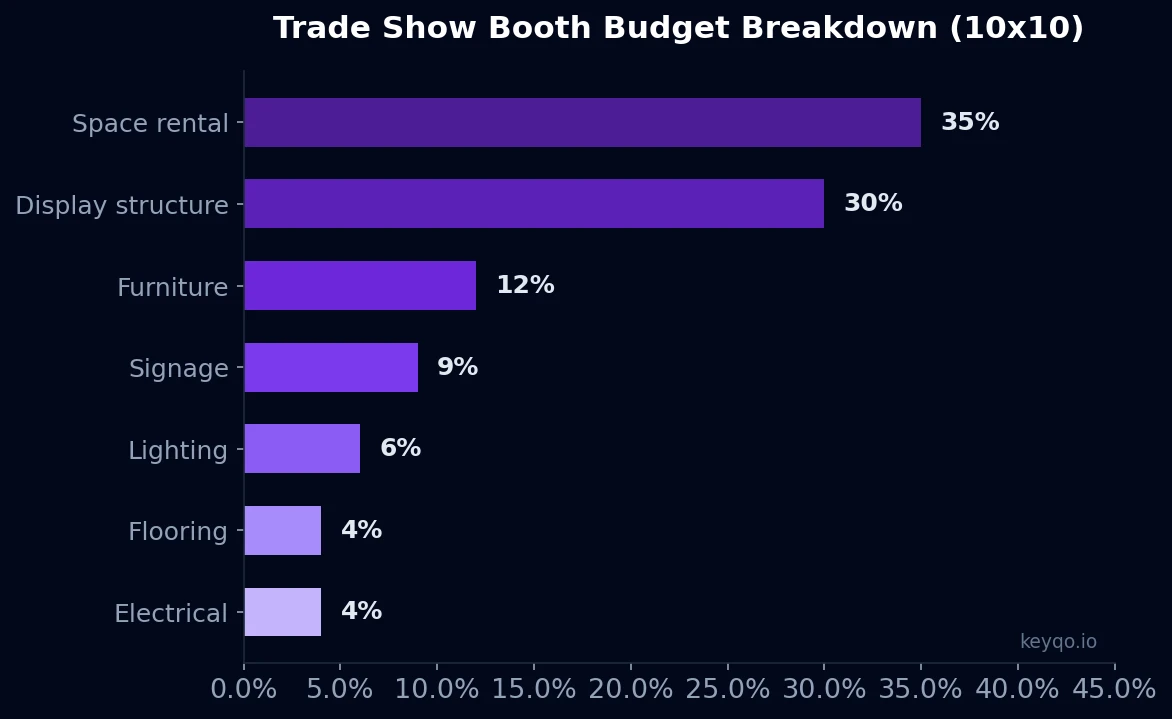
Here's a realistic breakdown for a 10x10 booth at a standard B2B trade show in the US:
| Item | Budget |
|---|---|
| Booth space rental | $2,000 – $5,000 |
| Display structure / walls | $900 – $7,000 |
| Furniture (rental) | $500 – $1,500 |
| Signage & graphics | $300 – $1,000 |
| Lighting | $200 – $600 |
| Flooring / carpet | $150 – $400 |
| Electrical | $200 – $500 |
| Total | $4,250 – $16,000 |
Add travel, accommodation, and staff costs. The real cost of exhibiting at a trade show is often double the "booth" budget alone.
Booth display design is one piece of the puzzle. But the big picture (interactive floor plans, online booth booking, exhibitor management) is what separates a well-run show from a chaotic one.
Keyqo gives organizers a single platform to manage their entire trade show: interactive floor plan, exhibitor management, online booking, and real-time analytics.
---
Sources: CEIR, 2024 CEIR Index Report ; IAEE, Best Practices for Exhibitors
Trade show booth ideas that drive traffic and qualified leads: real budgets, formats, technologies, mistakes to avoid and real-world examples.
Calendar of gastronomy and wine fairs across France in 2026, by city and region. Budget, exhibitor tips, organizer logistics: the complete guide.

Calculate the real profitability of a trade show: hidden costs, realistic revenues, and optimization levers. Field data and proven methods.